
Health Library
Best Birth Control for Mood Stability: What to Know
February 23, 2026
Question on this topic? Get an instant answer from August.
If you have noticed mood swings, irritability, or low feelings after starting birth control, you are not imagining it. Some hormonal contraceptives can affect your mood, while others may actually help keep it steady. The "best" option depends on your body, your history, and how sensitive you are to hormonal changes.
There is no single birth control that works perfectly for everyone's mood. But certain types are generally better tolerated than others.

Why Does Birth Control Affect Mood in First Place?
Hormonal birth control works by introducing synthetic versions of estrogen and progesterone (called progestin) into your body. These synthetic hormones suppress ovulation and prevent pregnancy. But they also interact with brain chemistry in ways that can influence how you feel emotionally.
Your brain has receptors for both estrogen and progesterone. When synthetic hormones replace your natural cycle, they change how neurotransmitters like serotonin and GABA function. Serotonin helps regulate mood, sleep, and well-being. GABA has a calming effect on nervous system. When these pathways shift, some women feel more anxious, more tearful, or emotionally flat.
A large review published through National Institutes of Health found that mood side effects from hormonal contraceptives are most consistent in women who already have a history of depression or previous negative experiences with hormonal birth control. For most women, hormonal contraceptives do not cause significant mood problems. But for a vulnerable subgroup, effects can be real and disruptive.
Which Types of Birth Control Are Easier on Mood?
Not all hormonal methods carry same risk. Here is what we know about how different options compare when it comes to emotional stability.
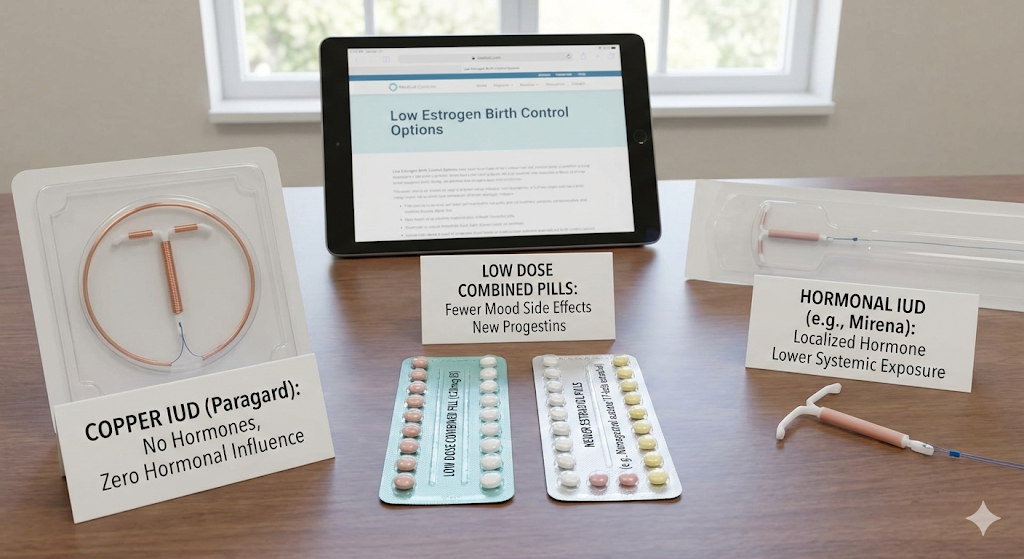
Copper IUD (Paragard)
This is clearest choice if you want zero hormonal influence on your mood. The copper IUD uses no hormones at all. It prevents pregnancy by creating an environment in uterus that toxic to sperm. Because there are no synthetic hormones involved, it has no direct effect on brain chemistry, serotonin, or GABA activity.
The tradeoff that copper IUDs can cause heavier periods and more cramping, especially in first few months. But if mood stability your top priority and you are sensitive to hormonal changes, this worth discussing with your provider.
Low dose combined pills
Combined pills contain both estrogen and progestin. Lower-dose formulations (those with 20 micrograms or less of ethinyl estradiol) tend to cause fewer mood-related side effects than higher-dose pills. The type of progestin also matters. Newer progestins like norgestimate and desogestrel are generally considered to have a milder hormonal profile.
Research published through National Institutes of Health has also explored newer combined pills that use estradiol (a form closer to your body's natural estrogen) instead of ethinyl estradiol. Early findings suggest these may be better tolerated by women who are prone to mood changes. One combination that has shown promise in pilot studies nomegestrol acetate with 17-beta estradiol, which appeared to produce a more positive mood response compared to older formulations.
If you want to understand how different estrogen levels in birth control pills compare, this guide breaks it down in more detail: Low Estrogen Birth Control Options
Hormonal IUD (Mirena, Kyleena, Liletta)
Hormonal IUDs release a small amount of levonorgestrel (a progestin) directly into uterus. Because hormone acts mostly locally, very little enters your bloodstream compared to pills, patches, or injections. This means systemic hormonal exposure is much lower.
For many women, this translates to fewer mood-related side effects. Some women do still notice emotional changes, especially in first few months after insertion. But overall, hormonal IUDs are considered one of better-tolerated options for women concerned about mood.
Which Methods Are More Likely to Affect Mood?
Some birth control methods have a stronger association with mood changes. This does not mean they will definitely cause problems for you, but if you are sensitive, it helps to know which ones carry more risk.
The Depo Provera shot (medroxyprogesterone acetate)
This injectable delivers a high dose of progestin that lasts for three months. Because you cannot stop it once it is injected, any side effects you experience will persist until hormone clears your system. Several studies have linked Depo-Provera to a higher rate of depressive symptoms compared to other methods. The hormonal dose significantly higher than what you get from an IUD or a low-dose pill.
The patch and vaginal ring
A large Danish study of over one million women found that patch users had highest relative risk of starting antidepressants compared to non-users. Vaginal ring users also showed an elevated risk. Both methods deliver hormones systemically, meaning hormones circulate throughout your entire body rather than acting locally.
The implant (Nexplanon)
The etonogestrel implant is progestin-only and delivers a steady dose over three years. Some women tolerate it well, while others report mood swings, anxiety, or depressive symptoms. The response varies widely from person to person. If you are considering implant and want to understand full picture of what to expect, this article covers broader side effect profile: Side Effects of Hormone Pellets
What If You Already Have Depression or Anxiety?
This is where conversation gets more nuanced. If you have a history of depression, anxiety, or mood disorders, your brain may be more sensitive to hormonal shifts. Research consistently shows that women with a prior history of depressive symptoms are most likely to experience mood side effects from hormonal birth control.
That said, there is an interesting exception. Women who suffer from premenstrual dysphoric disorder (PMDD), a severe form of PMS that causes intense mood swings tied to menstrual cycle, sometimes feel better on continuous hormonal birth control. This because steady hormone levels can eliminate natural rises and falls that trigger PMDD symptoms. In these cases, a continuous-dose combined pill (taken without placebo week) may actually improve mood stability rather than worsen it.
The key takeaway is that a method that worsens mood in one woman might stabilize it in another. Your personal history matters more than any general recommendation.
How to Find What Works for You
Finding right birth control for mood stability often takes some trial and observation. Here are a few practical steps that can help.
- Track your mood daily for at least two to three months after starting a new method. Use a simple journal or an app. Note patterns around energy, irritability, sadness, or anxiety.
- Start with lower-dose hormonal options if you know you are sensitive. A low-dose combined pill or a hormonal IUD is a reasonable first step.
- If mood changes appear within first four to twelve weeks of a new method, tell your doctor. This timeline is when hormone-related mood effects are most likely to show up.
- Consider non-hormonal options like copper IUD if you have tried multiple hormonal methods and consistently experienced mood problems.
- Do not push through severe mood changes. If you feel persistently sad, anxious, or emotionally numb after starting birth control, that is worth a conversation with your provider sooner rather than later.
Bottom Line
There is no universal "best" birth control for mood stability, but some options are clearly gentler than others. The copper IUD removes hormones from equation entirely. Low dose combined pills and hormonal IUDs tend to cause fewer mood disruptions than shot, patch, or ring. If you have a history of mood disorders, your provider can help you weigh benefits and risks of each option based on your specific situation. The most important thing is to pay attention to how you feel and speak up if something does not seem right.
Health Companion
trusted by
6Mpeople
Get clear medical guidance
on symptoms, medications, and lab reports.