
Health Library
Does Urgent Care Bill You Later Without Insurance?
February 16, 2026
Question on this topic? Get an instant answer from August.
It depends on the clinic, but most urgent care centers expect some form of payment at time of your visit when you do not have insurance. That said, you can sometimes receive a bill later, especially if lab work or imaging was part of your care.
If you are worried about walking into urgent care without insurance, thats completely understandable. But once you know how it works, you can feel more prepared. Let's break it down.
Do You Have to Pay Upfront Without Insurance?
In most cases, yes. Many urgent care centers ask uninsured patients to pay before or right after receiving treatment. This could be full estimated cost or a partial deposit.
The reason is simple. When you have insurance, the clinic bills your insurance company. Without insurance, there is no third party to bill. So clinic collects payment directly from you.
However, policies vary from clinic to clinic. Some collect a flat fee upfront and send a separate bill later if additional charges come up. Others may require full payment before you see a provider. Calling ahead always a smart move so there are no surprises when you arrive.
When Might You Get a Bill Later?
Even if you pay something upfront, there are situations where an urgent care center may still send you a bill afterward.
Here are most common reasons you might receive a later bill:
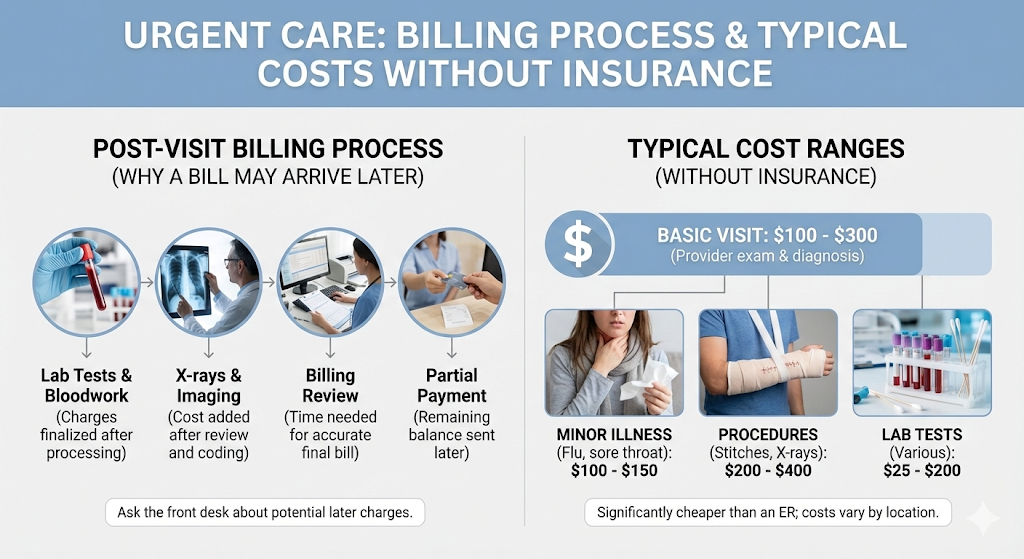
- Lab tests or bloodwork. The charges for tests may not be finalized until results are processed after you leave.
- X-rays or imaging. Diagnostic imaging adds to your cost and sometimes cannot be calculated until images are reviewed and coded.
- Billing review. Medical billing teams need time to assign correct codes and generate an accurate final bill. This can take a few days to a few weeks.
- Partial payment was collected. If you paid a deposit at check-in, any remaining balance gets mailed or emailed to you later.
So paying something on spot does not always mean you are done. Ask front desk whether you can expect additional charges after your visit.
How Much Does Urgent Care Cost Without Insurance?
The cost of an urgent care visit without insurance typically falls between $100 and $300 for a basic visit. This covers seeing a provider, getting examined, and receiving a diagnosis.
Additional services can increase that number. A straightforward visit for something like a sore throat or mild flu usually stays around $100 to $150. Visits requiring X-rays, stitches, or splinting can push total closer to $200 to $400. Lab tests add anywhere from $25 to $200 depending on what is ordered.
These numbers vary by location and clinic. Clinics in larger cities may charge more than those in smaller towns. But important thing is that urgent care is still significantly cheaper than an emergency room, which can easily cost thousands for similar treatment. For many people, urgent care is most affordable option when their regular doctor not available.
Can Urgent Care Turn You Away Without Insurance?
This is a concern many people have, and answer is yes, some clinics can. Unlike emergency rooms, which are legally required to treat you regardless of ability to pay, urgent care centers are private businesses that set their own policies.
Most clinics will still see you. They understand not everyone has insurance. But if you cannot pay anything at all, some may not provide services. This is uncommon, but it can happen.
If you are concerned, call ahead. Ask about their policy for uninsured patients and what payment methods they accept.
Are There Ways to Lower Your Urgent Care Bill?
Yes, and a little effort can save you real money. Many clinics offer options that make visits more affordable, even without insurance.
- Ask about self-pay discounts. Many clinics offer a reduced rate for out-of-pocket patients. Some call it a "cash pay" or "prompt pay" discount.
- Request a cost estimate before treatment. Most clinics can give you a rough estimate based on reason for your visit.
- Ask about payment plans. If your bill; more than you can handle at once, many clinics will work with you on monthly payments.
- Request an itemized bill. A detailed breakdown helps you catch errors or question charges that seem off. Billing mistakes are not uncommon.
- Look into community health centers. Federally qualified health centers offer services on a sliding fee scale based on income. This can be a great alternative when urgent care costs feel out of reach.
What Should You Bring to Urgent Care Without Insurance?
Walking in prepared makes whole experience smoother. Even without an insurance card, bring a valid photo ID and a form of payment. Most clinics accept credit cards, debit cards, and sometimes cash.
It also helps to bring a list of any medications you take and a brief summary of your medical history. This gives provider important context for your care.
Conclusion
Not having insurance does not mean you should skip medical care when you need it. Urgent care centers exist to provide affordable, accessible treatment for non emergency health concerns. The costs are manageable, especially compared to an emergency room.
Most clinics genuinely want to help you find a way to pay that works for your situation. Many of them deal with uninsured patients every single day and have systems in place to make it work.
If you are feeling unwell and need to be seen. Call clinic, ask about their policies, and go get care you need. A minor health issue treated early is almost always less expensive and less complicated than one that gets ignored. Your health matters more than a billing process, and there are more options available to you than you might think.
Health Companion
trusted by
6Mpeople
Get clear medical guidance
on symptoms, medications, and lab reports.