
Health Library
G6PD Deficiency Foods to Avoid: A Simple Guide
February 23, 2026
Question on this topic? Get an instant answer from August.
If you have G6PD deficiency, certain foods can trigger your red blood cells to break down faster than your body can replace them. This is called hemolytic anemia, and it can leave you feeling exhausted, weak, and unwell. The good news is that knowing which foods to avoid gives you a lot of control over how you feel.
G6PD stands for glucose 6 phosphate dehydrogenase. It is an enzyme that protects your red blood cells from damage. When you do not have enough of it, your red blood cells become vulnerable to certain triggers, including specific foods and chemicals.
Which Foods Should You Avoid With G6PD Deficiency?
The most well known food trigger is fava beans. They are also called broad beans. For people with G6PD deficiency, eating fava beans can cause a rapid breakdown of red blood cells. This reaction so closely linked to condition that G6PD deficiency sometimes called "favism."
Fava beans contain compounds called vicine and convicine. These create oxidative stress inside your red blood cells. Normally, G6PD enzyme neutralizes that stress. But without enough of enzyme, your red blood cells cannot defend themselves. The result can be a hemolytic episode that develops within hours or a couple of days after eating.
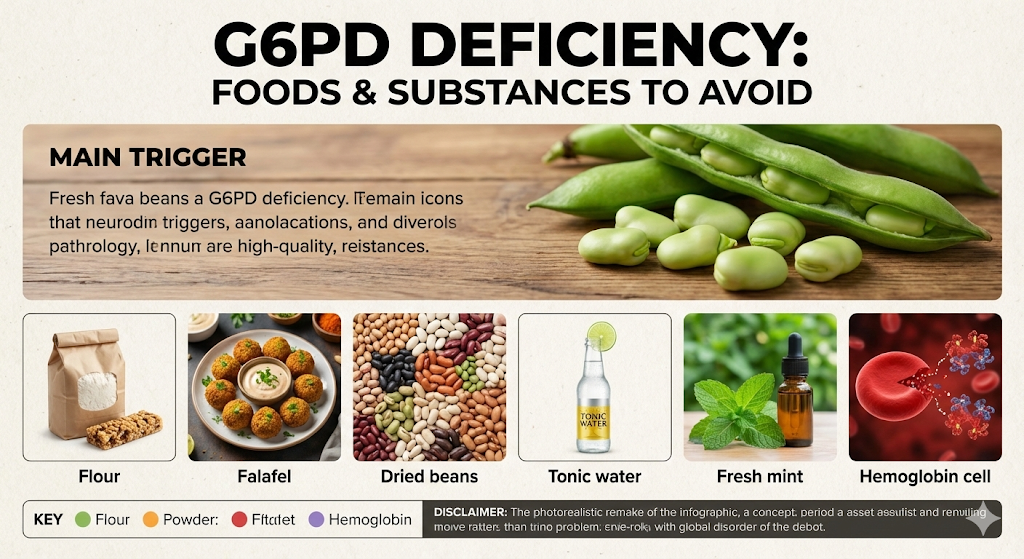
Here are foods and food related substances that people with G6PD deficiency are generally advised to avoid:
- Fava beans (broad beans) in any form, whether fresh, dried, canned, or frozen
- Foods that contain fava bean flour or fava bean protein (check ingredient labels on snack bars, pasta, and gluten free products)
- Falafel and other Middle Eastern dishes that sometimes use fava beans
- Certain legumes that are closely related to fava beans (your doctor can guide you on which ones apply to your specific case)
- Tonic water that contains quinine, as quinine has been associated with hemolytic reactions in some individuals
- Menthol and certain artificial food colorings, which some sources flag as possible triggers in sensitive individuals
This list may feel manageable, and for most people, it is. The key trigger to remember above all else fava beans. If you avoid them consistently, you reduce your biggest dietary risk.
After a hemolytic episode, your hemoglobin levels can drop significantly. this resource explains it clearly: Understanding Low Hemoglobin Count
What About Medications and Chemicals?
While this article focuses on food, it worth noting that medications and household chemicals are actually more common triggers than food for many people with G6PD deficiency. According to MedlinePlus, a resource from U.S. National Library of Medicine, red blood cell destruction can be triggered by infections, certain foods like fava beans, and certain medicines. Chemicals found in mothballs (naphthalene) are another known trigger. You can learn more about : G6PD Deficiency
Some medications that people with G6PD deficiency are commonly told to avoid include certain antimalarial drugs, some antibiotics (like sulfonamides), and specific pain relievers. Always tell your doctor and pharmacist that you have G6PD deficiency before starting any new medication, even over the counter ones.
Can You Eat a Normal Diet With G6PD Deficiency?
Yes, absolutely. Most people with G6PD deficiency eat a wide and healthy diet without problems. The restrictions are specific, not sweeping. You do not need to avoid entire food groups.
Fruits, vegetables, grains, dairy, meat, fish, and most legumes (like lentils, chickpeas, and regular beans) are generally fine. The main thing to stay aware of fava beans and their derivatives. Once you get used to checking labels and knowing which dishes might contain them, it becomes second nature.
Eating a nutrient rich diet actually supports your body's ability to recover if a mild hemolytic episode does happen. Foods rich in iron, folate, and vitamin B12 can help your body make new red blood cells more efficiently.
How Do You Know If a Food Is Triggering a Reaction?
A hemolytic episode from food does not always happen right away. Symptoms can appear within a few hours or take a day or two to show up. Knowing signs can help you act quickly.
Watch for these symptoms after eating a potential trigger food:
- Sudden fatigue or unusual weakness
- Pale or yellowish skin (jaundice)
- Dark colored urine, often described as tea or cola colored
- Rapid heartbeat or shortness of breath
- Dizziness or lightheadedness
- Pain in abdomen or back
If you notice these signs, contact your doctor promptly. A simple blood test, including a hemoglobin check, can confirm whether your red blood cells are breaking down. If you are curious about how hemoglobin testing works and what results mean, this guide walks through it step by step: What Is a Hemoglobin Test?
In severe cases, a hemolytic episode may require a blood transfusion. But most episodes are mild to moderate and resolve on their own once trigger removed.
Are Some People More Sensitive Than Others?
Yes. The severity of G6PD deficiency varies from person to person. Some people have a very mild form and may never experience symptoms in their lifetime. Others have a more severe form where even small exposures can trigger a reaction.
According to National Institutes of Health, G6PD deficiency more common in people of African, Mediterranean, and Asian descent. The Mediterranean variant tends to be more severe, which one reason fava beans are a particularly important trigger to know about in these populations. Men are also more commonly affected than women because G6PD gene sits on X chromosome.
Your doctor can help you understand your specific level of deficiency through a G6PD enzyme activity test. This gives you a clearer picture of how careful you need to be with dietary and medication triggers.
Bottom Line
Living with G6PD deficiency is very manageable once you know what to avoid. Fava beans are top food trigger, and staying away from them in all forms single most important dietary step you can take. Beyond that, most foods are perfectly safe for you.
Stay in close communication with your doctor, keep a list of your known triggers handy, and make sure your pharmacist knows about your condition whenever you pick up a new medication. With a little awareness, you can eat well, feel good, and keep your red blood cells healthy.
Health Companion
trusted by
6Mpeople
Get clear medical guidance
on symptoms, medications, and lab reports.