
Health Library
Saxenda vs Zepbound: Which Weight Loss Injection Is Right for You?
February 19, 2026
Question on this topic? Get an instant answer from August.
Saxenda and Zepbound are both FDA-approved injectable medications for weight loss. They work in similar ways but have key differences in how much weight they help you lose, how often you inject, and how they act inside your body. If you are trying to decide between them, understanding these differences can help you have a better conversation with your doctor.
Let us break down what each medication does and how they compare.
How Does Saxenda Work?
Saxenda contains an active ingredient called liraglutide. It belongs to a class of medications known as GLP-1 receptor agonists. GLP-1 is a hormone your gut naturally releases after you eat. It tells your brain you are full and slows down how quickly food leaves your stomach.
Saxenda mimics this hormone. When you inject it, your appetite decreases and you feel satisfied with smaller portions. This makes it easier to stick to a reduced-calorie diet over time.
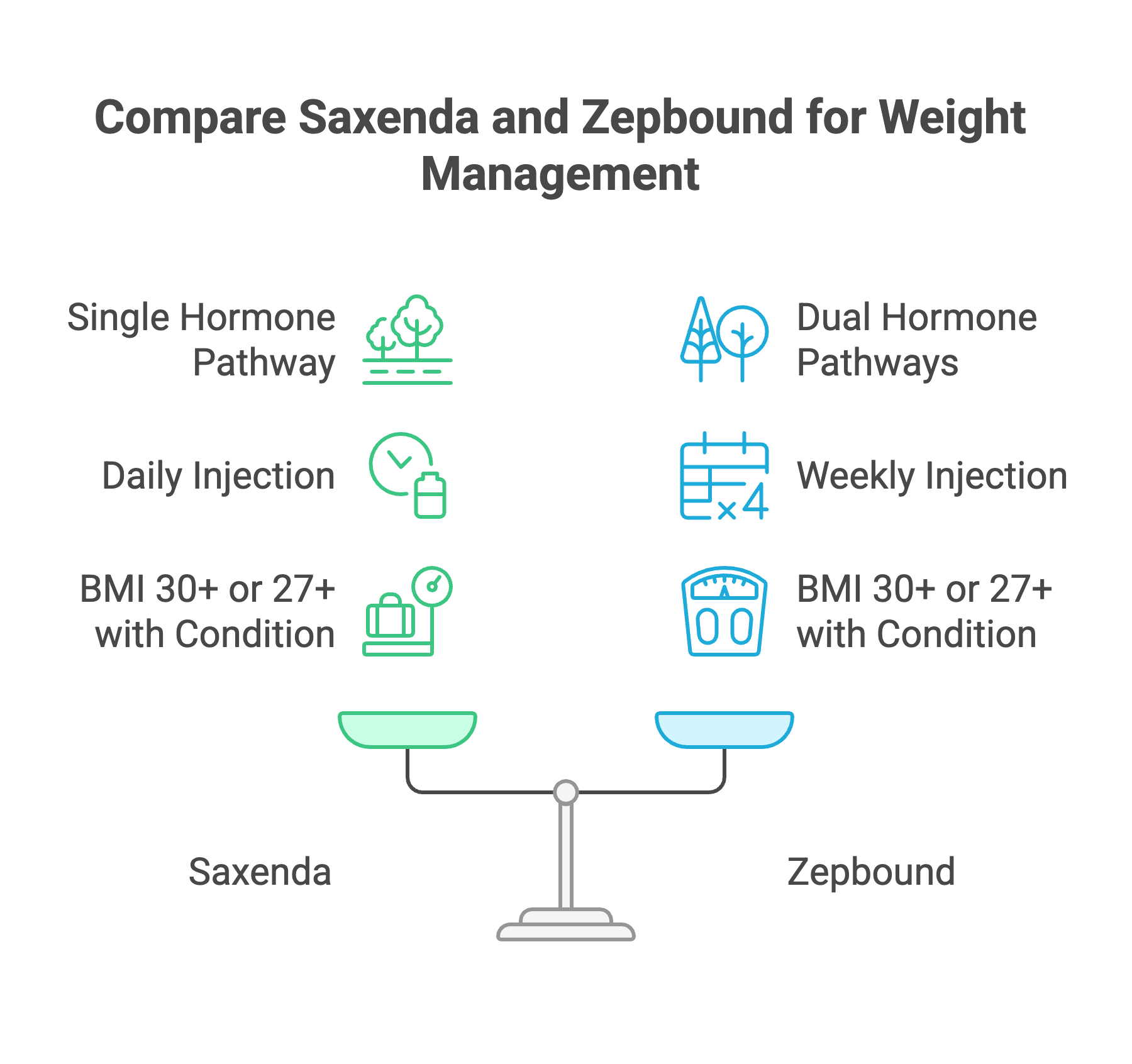
Saxenda is a daily injection. You start at a low dose of 0.6 mg and gradually increase over several weeks until you reach full dose of 3 mg per day. This slow ramp-up helps your body adjust and can reduce chance of stomach-related side effects early on.
It is approved for adults with a BMI of 30 or higher, or a BMI of 27 or higher if you also have a weight-related health condition like high blood pressure or type 2 diabetes. Saxenda is also approved for teens aged 12 and older with obesity.
How Does Zepbound Work?
Zepbound contains tirzepatide. It works on two hormone pathways instead of one. It activates both GLP-1 receptors and GIP receptors. GIP stands for glucose-dependent insulinotropic polypeptide, another gut hormone involved in appetite and blood sugar control.
This dual action is what sets Zepbound apart. By targeting two pathways, it can reduce appetite more strongly, improve how your body uses insulin, and may even help your body burn more energy at rest. You can think of it as having two keys turning two separate locks at same time.
Zepbound is a once-weekly injection. You start at 2.5 mg per week and increase gradually, with a maximum dose of 15 mg per week. The weekly schedule is more convenient for many people compared to daily injections.
It is approved for adults with a BMI of 30 or higher, or a BMI of 27 or higher with at least one weight-related health condition. Zepbound is also approved to treat moderate-to-severe obstructive sleep apnea in adults with obesity. If you want to understand more about how tirzepatide compares to other newer weight loss medications, this comparison of similar injectable treatments covers helpful details.
How Much Weight Can You Expect to Lose?
In clinical trials, people taking Saxenda lost an average of about 5% to 10% of their body weight over 56 weeks. For someone weighing 200 pounds, that works out to roughly 10 to 20 pounds. About two-thirds of people on Saxenda achieved at least 5% weight loss, which is considered clinically meaningful.
Zepbound showed significantly greater results. In trials, people on highest dose of tirzepatide lost an average of about 21% of their body weight over 72 weeks. For that same 200-pound person, that could mean losing around 42 pounds. More than half of participants on higher doses lost over 20% of their starting weight.
A head-to-head study comparing tirzepatide with semaglutide (another GLP-1 medication more potent than Saxenda) showed that tirzepatide produced greater weight loss. These results suggest that Zepbound's dual-hormone approach gives it a clear edge in terms of average pounds lost as outlined in this clinical research summary.
It is worth remembering that individual results vary. Some people respond better to one medication than other. Your genetics, lifestyle, diet, and how well you tolerate medication all play a role.
What Are Side Effects?
Both medications share similar side effects because they both work on GLP-1 pathways. most common issues involve your digestive system.
With Saxenda, common side effects include nausea, diarrhea, constipation, vomiting, low blood sugar, headaches, and injection site reactions. Nausea is most frequently reported issue, and it tends to improve as your body adjusts to medication over first few weeks.
Zepbound causes many of same digestive side effects. Nausea, diarrhea, vomiting, constipation, and stomach discomfort are all common. Some people also experience fatigue, hair thinning, and belching. The side effects are usually most noticeable during dose increases and often settle down with time.
Both medications carry serious but rare warnings. These include a potential risk of thyroid tumors (based on animal studies), pancreatitis, gallbladder problems, and kidney issues. Neither Saxenda nor Zepbound should be used by anyone with a personal or family history of medullary thyroid carcinoma or a condition called multiple endocrine neoplasia syndrome type 2.
If you experience nausea that feels hard to manage during early weeks, eating smaller meals, staying hydrated, and avoiding greasy foods can help. Fatigue is another common adjustment your body goes through with GLP-1 medications, and this guide on unexplained tiredness and body aches may offer useful context.
How Do Dosing Schedules Compare?
This is a practical detail that matters more than people expect.
Saxenda requires a daily injection. You inject it under skin of your stomach, thigh, or upper arm at same time each day. Some people find daily routine easy to remember. Others feel it becomes tedious over months and years.
Zepbound requires one injection per week. You choose same day each week and inject under skin. For many people, a weekly injection feels much more manageable and fits more easily into a busy schedule.
What About Cost and Insurance?
Both medications can be expensive without insurance. Saxenda typically costs around $1,000 to $1,300 per month out of pocket. Zepbound runs about $1,000 to $1,100 per month without coverage. A generic version of liraglutide (the active ingredient in Saxenda) recently received FDA approval, which may make Saxenda's option more affordable over time.
Insurance coverage for both medications varies widely. Some plans cover one but not other. Some require prior authorization or proof that diet and exercise alone have not been enough. It is worth checking with your insurance provider before committing to either medication.
Which One Might Be Better for You?
There is no single right answer. Both medications are effective tools for weight management. Here are some things that may help guide your decision.
Zepbound may be a better fit if you are looking for maximum weight loss, you prefer a weekly injection, or you also have obstructive sleep apnea related to obesity.
Saxenda may be a better fit if you are under 18 and eligible for treatment, you prefer a medication with a longer track record, or generic pricing makes it more affordable for your situation.
Your doctor will also consider your medical history, current medications, kidney and liver function, and any other health conditions before recommending one over other.
The Bottom Line
Saxenda and Zepbound both help with weight loss by reducing appetite and helping you feel full longer. Zepbound works on two hormone pathways and tends to produce greater average weight loss. Saxenda targets one pathway and has been around longer, with a generic version now available. Both require a prescription and work best alongside a healthy diet and regular physical activity. Talk with your healthcare provider about which one aligns with your health goals, your budget, and your lifestyle.
Health Companion
trusted by
6Mpeople
Get clear medical guidance
on symptoms, medications, and lab reports.