
Health Library
Toenail Hematoma vs Melanoma: How to Tell Difference
February 19, 2026
Question on this topic? Get an instant answer from August.
A toenail hematoma is a bruise under your nail from an injury. Melanoma is a rare but serious skin cancer that can also develop under nail. They can look similar at first glance, but they behave very differently over time. Knowing what to watch for can help you catch something serious early or simply put your mind at ease.
Let us walk through exactly how these two conditions differ and when you should see a doctor.
What Is a Toenail Hematoma?
A toenail hematoma is simply blood trapped between your nail bed and your nail plate. It happens when tiny blood vessels under your nail get damaged.
The most common cause trauma. You might stub your toe, drop something heavy on your foot, or wear shoes that press too tightly against your toenails during long walks or runs. Runners, hikers, and athletes who make sudden stops often deal with this.
After injury, blood collects under nail and creates a dark patch. The color can range from red to deep purple to black, depending on how much blood has pooled and how old bruise is. A research study looking at 47 cases of subungual hematomas found that most common color was purple-black, appearing in about 53% of cases.
The key thing about a hematoma is that it hurts, especially when you press on nail. You usually know exactly what caused it. And most importantly, dark spot moves forward as your nail grows out. Over several weeks to months, discolored area gradually shifts toward tip of your toe and eventually grows out completely.
What Is Subungual Melanoma?
Subungual melanoma is a type of skin cancer that develops in melanocytes, pigment-producing cells beneath your nail. It quite rare, making up roughly 0.7% to 3.5% of all melanoma cases worldwide.
Unlike most melanomas, this type not caused by sun exposure. Researchers are still working to understand its exact causes, but genetic factors and repeated nail trauma may play a role. It tends to affect big toe or thumb most often.
The condition usually starts as a dark, vertical line or band running from base of nail toward tip. Over time, this line may widen, especially at base near cuticle. The nail itself might become damaged, cracked, or lifted.
One hallmark sign something doctors call Hutchinson sign. This happens when dark pigment spreads beyond nail onto surrounding skin of cuticle or nail fold. This is a strong warning sign that pigment not just a bruise.
Subungual melanoma affects people of all skin tones. However, it accounts for a much higher percentage of melanoma cases in people with darker skin. Among African American patients, it can represent up to 30% of all melanoma diagnoses as outlined in this medical reference on condition.
How Can You Tell Them Apart?
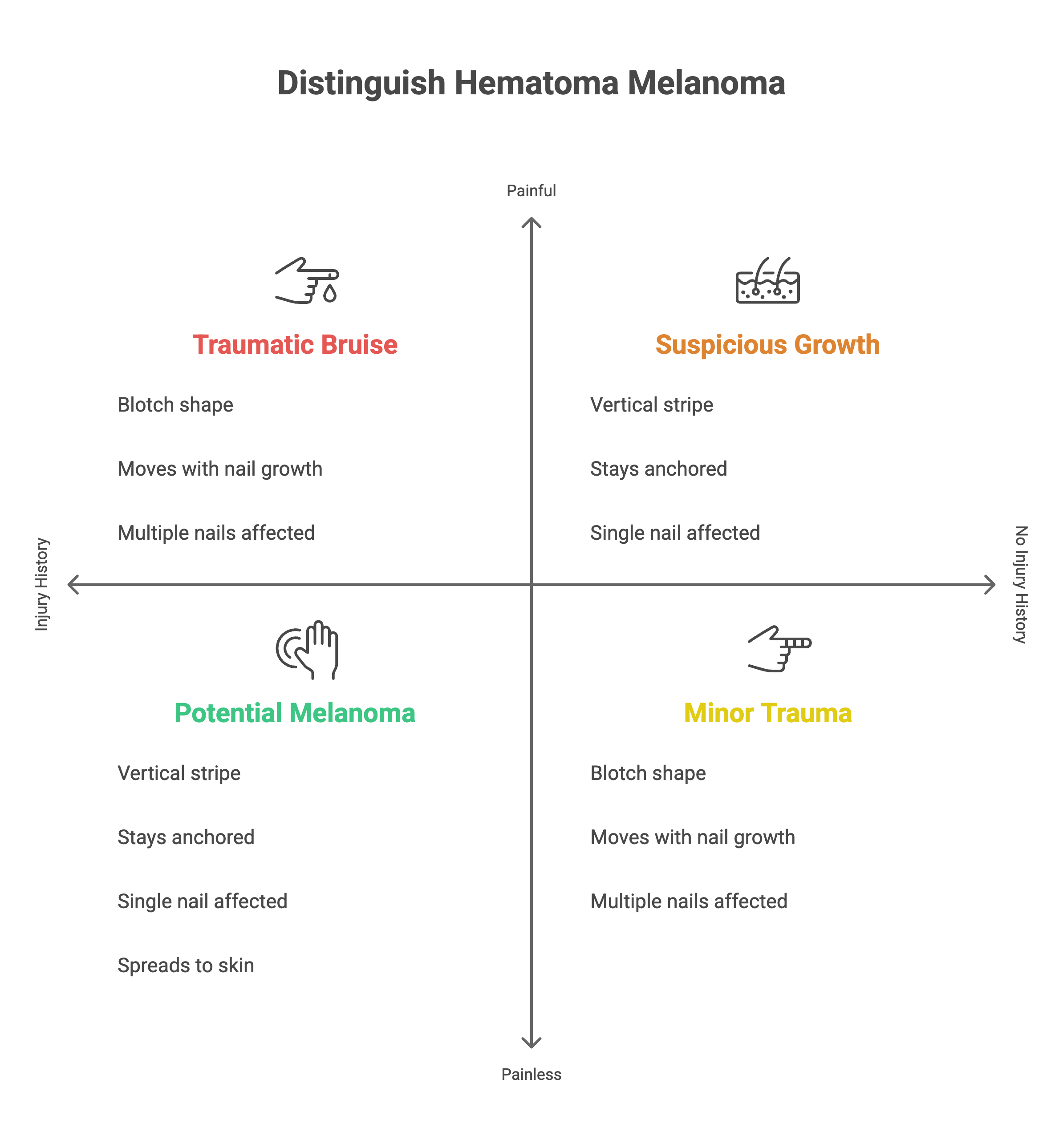
The differences between a hematoma and melanoma become clearer when you know what to look for. Here how they compare across several key features.
- History of injury. A hematoma almost always follows a specific injury or repetitive pressure. You can usually trace it back to an event. Melanoma appears without any clear cause.
- Pain. Hematomas are tender, especially when pressed. Melanoma is usually painless in its early stages.
- Shape of dark area. A hematoma typically looks like a blotch, smudge, or round patch of color. Melanoma usually appears as a vertical stripe or band running lengthwise down nail.
- Movement over time. This is one of most reliable differences. A hematoma moves toward tip of nail as it grows out. Melanoma stays anchored in place because pigment is being produced at nail root.
- Number of nails affected. Tight shoes can cause hematomas on multiple toenails, often on both big toes. Melanoma almost always affects a single nail.
- Skin involvement. A hematoma stays under nail plate. Melanoma can spread pigment onto skin around nail, which is Hutchinson sign mentioned earlier.
- Nail damage. A hematoma might cause nail to lift or fall off, but a healthy new nail grows back underneath. Melanoma can cause nail to crack, thin, split, or become permanently deformed.
If you are ever unsure about a dark mark on your toenail, especially one that appeared without an obvious injury, seeing a dermatologist is safest step.
Who Is More at Risk for Nail Melanoma?
Subungual melanoma can happen to anyone, but certain groups face a higher risk.
People over 50 are more commonly affected. Most cases are diagnosed in people between ages of 50 and 70.
People with darker skin tones have a disproportionately higher rate of nail melanoma compared to other forms of melanoma. This is partly because subungual melanoma is not related to sun exposure, which drives most melanoma cases in lighter-skinned populations.
Those with a family history of melanoma should be especially vigilant about any new or changing pigmented marks on their nails.
People who have experienced repeated trauma to nail may also have a slightly elevated risk, though link between trauma and melanoma is still being studied.
Because skin conditions can sometimes look confusing, it helps to pay attention to any changes in your nails as part of your overall skin awareness. If you are someone who deals with ongoing skin concerns, understanding how different conditions present on your body can be valuable. This guide on recognizing common skin conditions and this overview on skin reactions from external triggers can help you build that awareness.
How Do Doctors Diagnose Each Condition?
For a suspected hematoma, your doctor may simply watch and wait. They can score a small mark on nail near edge of dark area and check back in a few weeks. If dark spot has moved forward with nail growth, that confirms its bruise growing out.
For a suspected melanoma, the process more involved. Your doctor will likely start with dermoscopy, which uses a specialized magnifying tool to examine pigment patterns under nail. Melanomas tend to show irregular, non-parallel lines under dermoscopy, while hematomas display a more uniform, blotchy pattern.
If dermoscopy raises concern, a nail biopsy is next step. This involves taking a small tissue sample from nail bed and examining it under a microscope. A biopsy is only way to confirm whether melanoma cells are present. Additional imaging like CT scans or MRI may follow if cancer is confirmed, to check whether it has spread.
When Should You See a Doctor?
You should have any dark mark on your toenail evaluated if it appeared without a clear injury, if it looks like a vertical stripe rather than a round blotch, if dark area getting wider over time, if you notice pigment spreading onto skin around nail, or if nail cracking, splitting, or becoming deformed without an obvious cause.
Early detection makes an enormous difference with nail melanoma. When caught at earliest stage, five year survival rate is around 97%. But if cancer spreads to distant organs, that number drops significantly. You can learn more about melanoma staging, early detection guidelines, and survival statistics from this government cancer resource.
The Bottom Line
A toenail hematoma is a common bruise that grows out with nail and heals on its own. Subungual melanoma is a rare cancer that stays in place, often appearing as a widening dark stripe. The easiest way to tell them apart is to watch whether dark spot moves forward as nail grows. If it does not, or if you notice any of warning signs above, see a dermatologist promptly. When it comes to dark marks on your nails, getting checked early always worth your peace of mind.
Health Companion
trusted by
6Mpeople
Get clear medical guidance
on symptoms, medications, and lab reports.